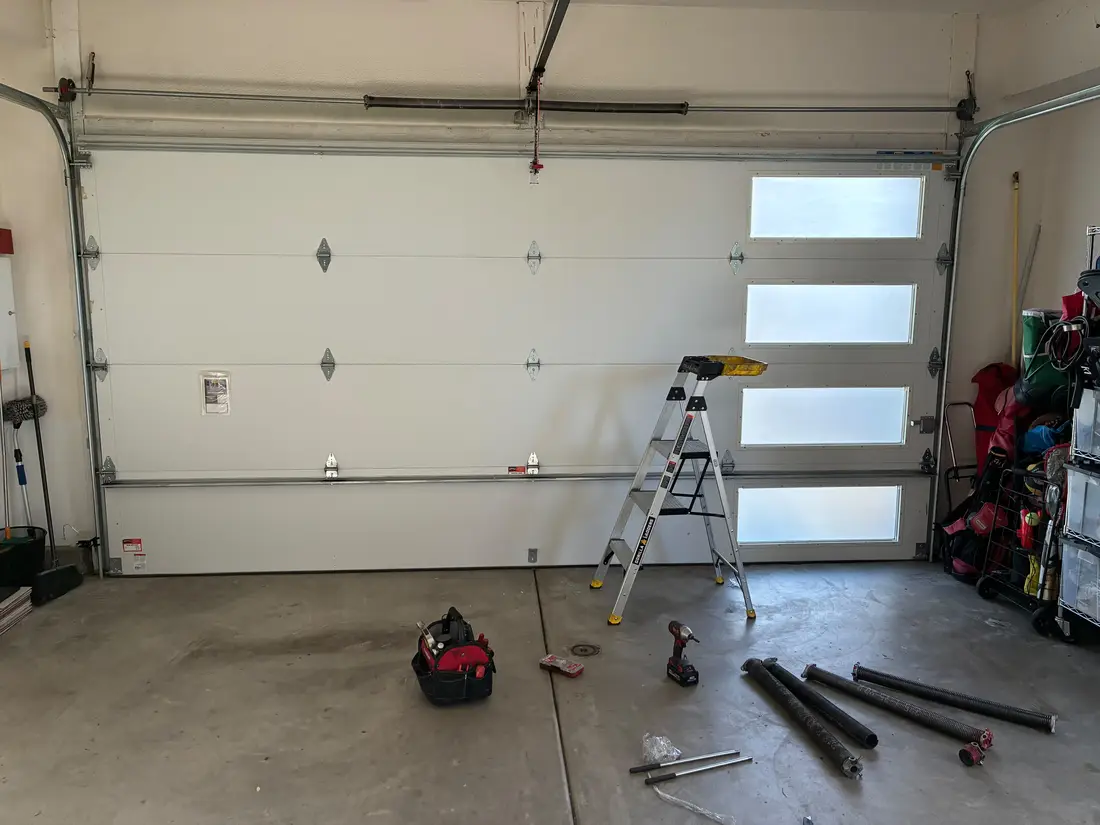
A garage door hanging crooked, rollers out of the track, is one of the few household problems where the wrong first move can genuinely hurt someone. The door weighs hundreds of pounds and is held by springs under high tension. Here is the safe sequence — the same one our emergency crews talk callers through.
Do this first
Stop using the opener. Every cycle against a derailed door bends tracks and panels further and can pull the whole door down. Unplug the opener or switch off its breaker if the switch is within safe reach — without standing in the doorway. Clear the area. Keep people and pets out of the garage and away from the door's fall zone on both sides. Do not pull the red release cord. The release disconnects the opener, which may be the only thing currently holding the door's position; releasing it can let the door drop. Call for emergency service and describe what you see: which side is out, whether the door is open, closed or halfway, and what happened just before.
Never do this
Do not try to muscle the door back into the tracks — a partially supported door can shift its full weight onto you without warning. Do not hammer tracks or rollers. Do not loosen the bottom brackets or touch cables and springs: those parts are under the tension that lifts the door, and a cable slipping off under load whips. Do not prop the door with a ladder or boards and park under it. Every one of these shows up in injury reports; every one is avoidable by simply waiting for a technician.
What usually causes a derailment
A vehicle tap. Even a slow bumper kiss can bend a track or pop rollers out on one side. A broken cable. One side loses lift, the door racks and rollers climb out — see our guide to spring and cable failure signs. Worn or broken rollers. A roller whose bearing seizes or whose wheel cracks can jump the track. An obstruction in the track — a tool, a chunk of ice, a child's toy — that a roller rides up and over. A door closed on an object with the opener's force set too high, driving the door off-line instead of reversing.
How a technician re-hangs the door
The work starts by securing the door so it cannot move, then unwinding spring tension in a controlled way. The crew inspects the tracks (straightening or replacing bent sections), replaces damaged rollers and any cable that frayed or jumped, reseats the door section by section, rewinds the springs to spec, and re-balances the door. Only then is the opener reconnected — and its force setting checked, so the door reverses on contact instead of muscling through. The visit ends with the full safety test our repair standard requires.
Preventing the sequel
Most derailments are the last act of a longer wear story: tired rollers, fraying cables, a door slowly going out of balance. An annual tune-up inspects exactly those parts. It is considerably cheaper than a 9 p.m. emergency — and considerably calmer.
Will insurance or a warranty cover it?
If a vehicle caused the damage, your auto or homeowner's policy may cover the door repair — photograph everything before anything is moved, and keep our written assessment for the claim. If the cause was a failed part on a door or opener still under the manufacturer's warranty, tell us when you call; we document failed components and can supply the part details your claim needs. Either way, do the safety steps first and the paperwork second — a derailed door does not become safer while forms are filled out.