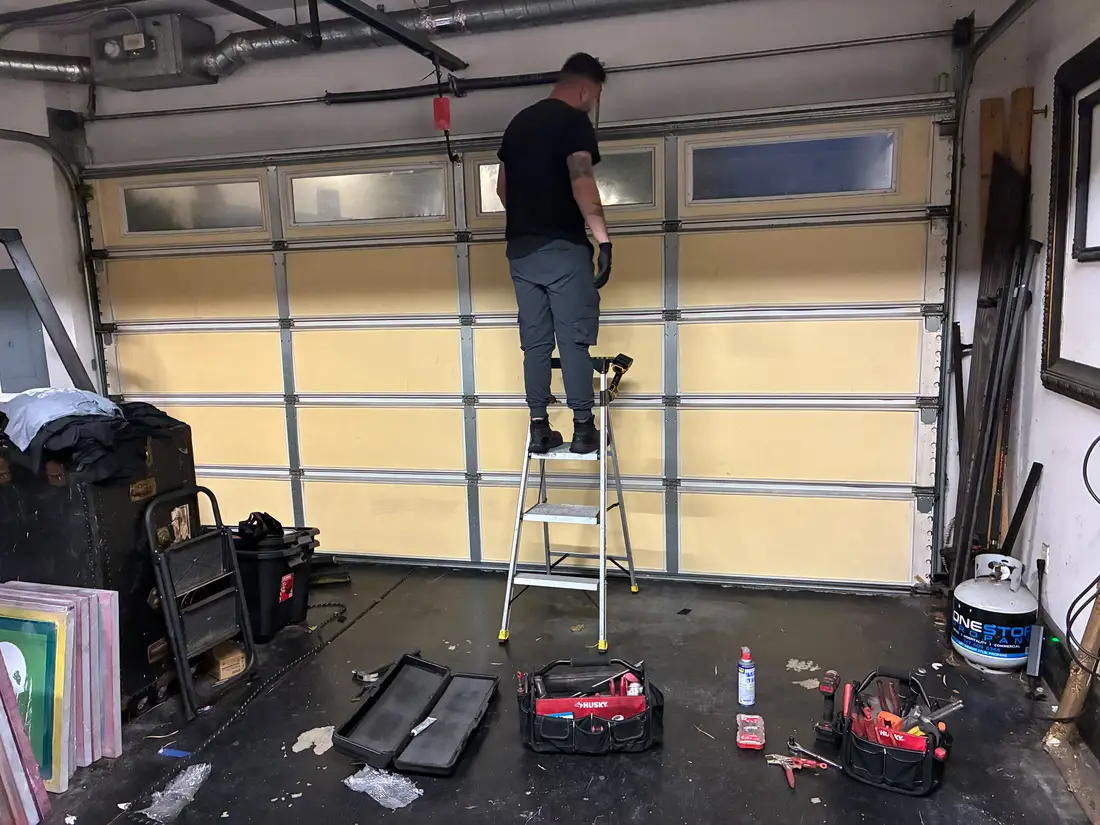
What garage door repair actually covers
A modern garage door is a system of interlocking parts: torsion or extension springs counterbalance the door's weight, cables transfer that lift to the drum and door, rollers guide the sections through tracks, hinges let the door bend around the curve, and the opener only has to do a fraction of the work when everything is balanced. When one part wears out, the others compensate — and wear faster. Good repair work means finding the part that failed first and checking everything it stressed.
Our repair visits cover the full mechanical system: snapped or frayed lift cables, worn steel or nylon rollers, bent or misaligned tracks, cracked hinges, damaged panels, loose hardware, worn bearings and end plates, weather seal failure, and doors that have come off their tracks. If your problem is in the spring system, see our broken spring replacement page; if the motor itself is the issue, our opener installation and repair page explains what we check there.
Signs your door needs a repair visit
Most doors warn you before they quit. Call for repair when you notice any of the following: the door opens a few inches and stops; it closes partway and reverses for no obvious reason; it moves unevenly, with one side higher than the other; you hear grinding, scraping, popping or squealing that was not there before; the door feels unusually heavy when you lift it by hand with the opener disconnected; a cable hangs loose or looks frayed; a roller has popped out of the track; or there is a visible gap at the bottom on one side. Each of these points to a specific component, and catching it early is the difference between a parts swap and a door replacement.
How we diagnose and repair your door
Every visit starts with a full inspection. We test the door's balance by disconnecting the opener and lifting the door manually — a properly balanced door stays where you leave it. We check spring tension and condition, cable wear at the bottom brackets, roller bearing play, track alignment and plumb, hinge cracks at the center stiles, and the opener's force and travel settings. Only after that inspection do we quote the repair, explain what failed and why, and show you the worn part.
Repairs are done with parts rated for your door's size and weight. Springs are matched by wire size, inside diameter and length — never guessed. Cables are replaced in pairs. Rollers are replaced as a set when bearing wear is the issue, because one bad roller usually means its neighbors are close behind. When the work is finished, we re-balance the door, set the opener's limits and force, test the safety reversal system, and lubricate every moving point.
Why a door that "still works" still needs fixing
The most expensive garage door repairs are the ones that were postponed. A frayed cable that lets go drops one corner of the door, which bends the track and can crack panels. An opener straining against a dead spring burns out its gear and sprocket — turning a spring job into a spring-plus-opener job. A door that reverses randomly trains everyone in the house to ignore the safety system, which is exactly backwards. If your door has changed how it sounds, feels or moves, that change is information. Acting on it early keeps the repair small.
Repair or replace?
Honest answer: most doors deserve repair. A door with sound panels and frame can run for decades with spring, cable and roller service. Replacement makes sense when multiple panels are damaged, the door is badly rusted or rotted, parts are no longer made for an obsolete system, or you are renovating and want the efficiency and curb-appeal upgrade. When replacement is the smarter call, we will say so and explain why — our new garage door installation page walks through the options. And if you are not sure what your door needs, a tune-up and safety check gives you a full written picture of its condition before you decide anything.
What a repair visit costs — and what moves the number
Homeowners understandably want a price before anyone touches the door, so here is how repair pricing actually works. The biggest factor is which component failed: rollers, hinges and sensors sit at the modest end; cables and hardware in the middle; springs and opener internals higher, because the parts cost more and the work involves tension and calibration. The second factor is scope — a door that needs one roller is a different job from a door that needs rollers, cables and a re-balance because all three wore out together. The third is access and door type: oversized, wood and wind-reinforced doors use heavier parts throughout.
What should never move the number is pressure. You will always get the quote after the inspection and before the work, in writing, with the option to decline and pay only for the visit. If a second problem is found mid-repair, we stop and tell you before touching it. That is the standard on every tune-up follow-up and every repair we run — and it is why we would rather lose a job than surprise a customer at the door.