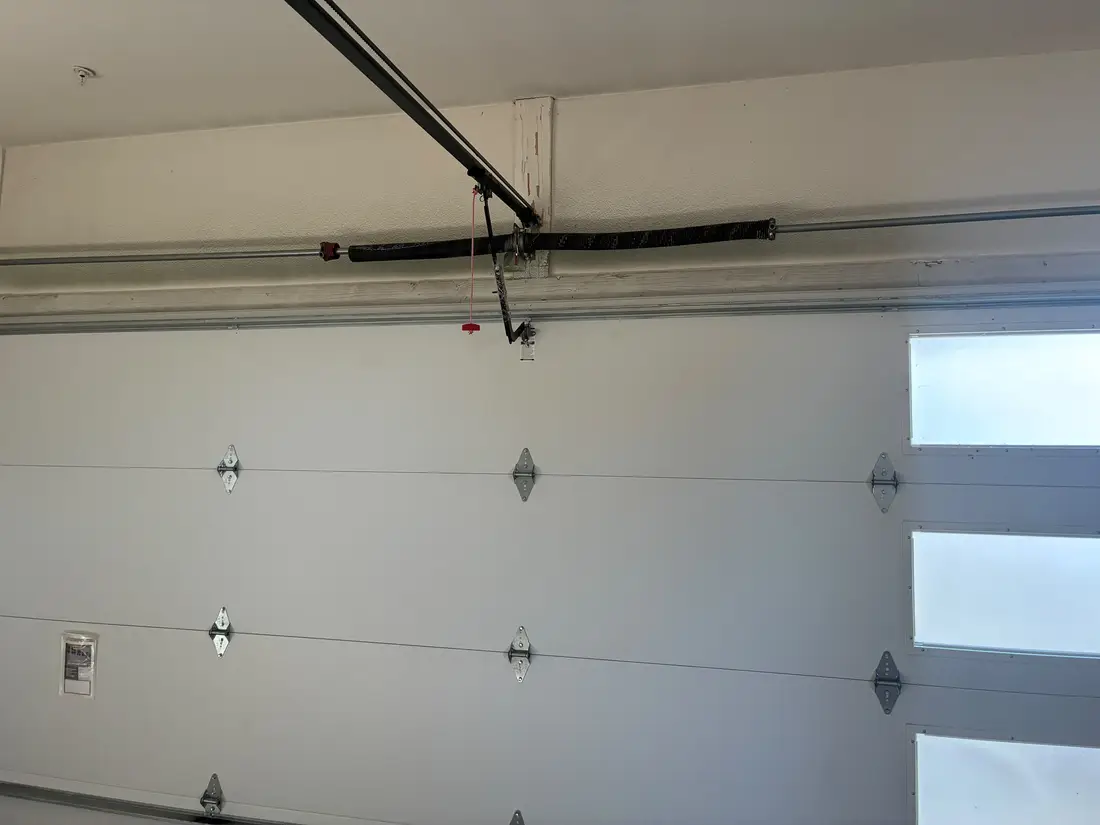
What the springs actually do
A typical steel garage door weighs 150 to 400 pounds. You can lift it with one hand because the spring system stores energy that counterbalances that weight. Torsion springs sit on a shaft above the door and wind up as the door closes, then unwind to help lift it. Extension springs stretch alongside the horizontal tracks and contract to provide lift. Either way, the opener's job is only to guide the door — when a spring breaks, the opener suddenly faces the full weight, which is why forcing the door with the opener after a spring failure often destroys the opener's gear or bends the top panel.
How to tell a spring has broken
The classic sign is a loud bang from the garage — often mistaken for something falling — followed by a door that will not open more than a few inches, or will not open at all. Other signs: a visible gap in the torsion spring above the door (a healthy spring is one continuous coil; a broken one separates into two pieces); the door lifts crookedly or feels impossibly heavy by hand; cables hang slack or have come off the drums; or the opener runs but the door barely moves. If you see the gap in the spring, the diagnosis is done — do not keep cycling the opener.
Why springs are replaced in pairs
Most two-spring systems have springs of the same age and cycle rating, and they fatigue together. Replacing only the broken one leaves the old spring to fail soon after — and leaves the door lifting unevenly in the meantime, which strains cables and the opener. Replacing both at once costs less than two separate emergency visits and gives you a matched, evenly balanced system. When we quote spring work, we quote the pair, and we will show you the condition of the spring that has not broken yet so you can see why.
Correct sizing is not optional
Springs are not generic. A torsion spring is specified by wire gauge, inside diameter, length and wind direction, and the correct combination is calculated from the door's weight, height, track radius and drum size. A spring that is too weak makes the door heavy and burns out the opener; too strong, and the door flies up and will not stay closed. We weigh or calculate the door, match the springs precisely, and wind them to the specified number of turns. Our garage door repair team carries the common sizes on the truck, so most spring jobs are completed in the same visit.
Cycle life: standard vs. high-cycle springs
Springs are rated in cycles — one cycle is one open-and-close. Standard springs are typically rated around 10,000 cycles, which for a household using the door four times a day is roughly seven years. If your garage is the main entrance to your home, ask us about high-cycle springs rated for 25,000 cycles or more: the upgrade costs modestly more at install time and stretches the next replacement far into the future. We will tell you honestly which rating makes sense for how you use your door.
Leave spring work to a technician
This is the one garage door job we will always talk homeowners out of attempting. A wound torsion spring holds enough stored energy to break bones, and it requires winding bars, vise clamps and knowledge of the exact turn count. Extension springs need safety cables threaded through them so a failure does not turn the spring into a projectile. Our technicians do this work daily, with the right tools and the right parts, and every spring job finishes with a full balance test, cable inspection and safety-reversal check — plus a tune-up of the moving parts while everything is apart.
What happens during a spring replacement visit
So there are no surprises, here is the sequence. The technician first confirms the diagnosis and measures the door and the broken spring — wire gauge, coil diameter and length — to spec the replacements exactly. The door is secured, spring tension is released in a controlled manner, and the old springs come off the shaft. Bearings and center plates are inspected while everything is exposed; worn ones are flagged, because a seized bearing will eat a new spring's smooth travel. The new pair is installed, wound to the calculated number of turns, and the set screws are torqued and marked.
Then comes the part that separates a spring swap from a spring job: the balance test. The door is lifted by hand to several heights and released — it should hover, not drift up or sink. Cables are checked for equal tension, the opener is reconnected, its force and travel are verified against the newly balanced door, and the safety reverse is tested with a physical obstruction. If the door does not pass any of those checks, we adjust until it does. The whole visit typically takes under ninety minutes, and you will know the price before the first winding bar comes out.