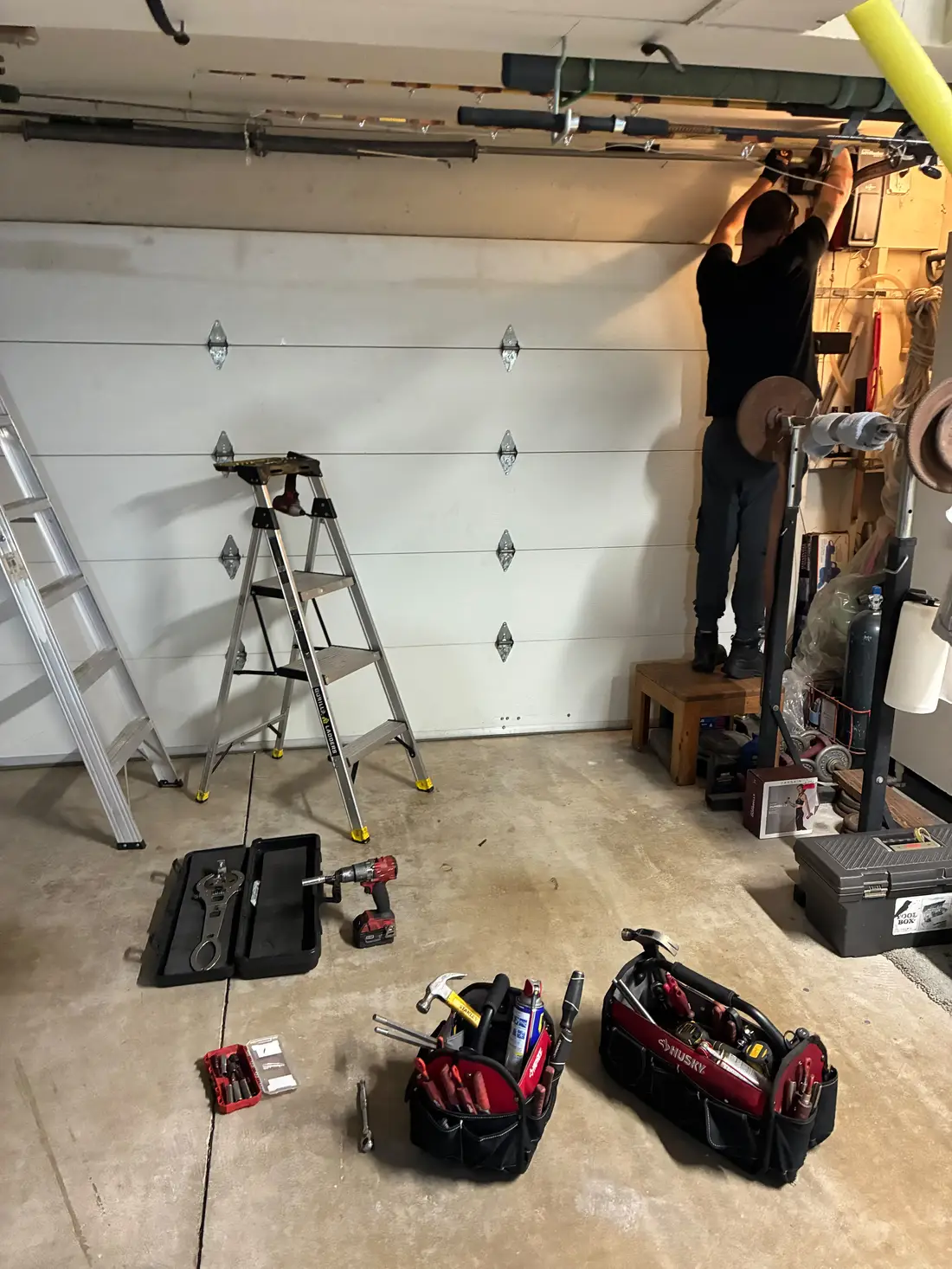
Repair first, when repair makes sense
Many opener problems are not the opener at all. A door that reverses mid-close is often a sensor or travel-limit issue. A motor that hums but does not move may have a stripped gear — a replaceable part on many models. Remotes that stop working can be a battery, a reprogram, or a failing receiver board. We start every opener call by checking the door's balance first, because a heavy door from a worn spring mimics opener failure and kills new openers too. If your door is hard to lift by hand, the real fix may be on our spring replacement page — and we will tell you that before selling you a motor.
Choosing a new opener: drive types
Chain drive is the workhorse: strong, affordable and a little louder — a fine choice for detached garages. Belt drive uses a steel-reinforced belt for much quieter operation, the usual pick when a bedroom sits above or beside the garage. Wall-mount (jackshaft) openers sit beside the door instead of on the ceiling, freeing overhead space for storage or tall vehicles and giving a clean look; they pair with torsion-spring doors. Screw drive models are less common today but still serviced. We help you choose based on door weight, ceiling layout and how much the noise matters in your house — not on which box has the biggest margin.
Horsepower and door size
Openers are sized by the door they must move. A standard single or double steel door runs well on a 1/2 HP equivalent AC motor or its DC counterpart; heavy wood doors, oversized doors and doors with wind-load reinforcement need 3/4 HP class or better. Modern DC motors with soft start and stop reduce vibration and wear on the door hardware, and most include battery backup that keeps the door working through a power outage — a feature worth having anywhere storms knock out power.
Smart openers and security
Today's openers add Wi-Fi control from your phone, alerts when the door opens or is left open, and integration with delivery services and home security systems. Just as important is the radio security: modern rolling-code technology changes the remote's code with every use, making the signal effectively impossible to clone. If your opener predates rolling code — or predates the 1993 requirement for photo-eye safety sensors — replacement is a genuine safety upgrade, not a luxury. Every installation includes programming your remotes and vehicle controls, setting up the app if you want it, and walking you through the manual release so you are never locked out by a dead motor.
What a proper installation includes
An opener is only as good as its setup. Our installations include: verifying door balance before the motor goes on; mounting and leveling the rail and header bracket into solid framing; aligning the photo-eye sensors at the correct height; setting travel limits so the door seals without slamming; setting force so the auto-reverse responds to a proper obstruction test; and testing the safety reversal with a block of wood, the way the standard requires. We finish by lubricating the door, checking the full hardware system, and hauling the old opener away if you want it gone.
When replacement beats repair
Replacement usually wins when the logic board has failed on a unit over 12–15 years old, the motor is burned out, parts are discontinued, the unit lacks safety sensors, or the repair cost approaches half the price of a new opener with a warranty. We will give you both numbers — repair and replace — with the reasoning, and let you decide. Whichever you choose, an annual tune-up keeps the door balanced so the opener lives its full life.
Remotes, keypads and the details nobody mentions
A good installation is finished in the details. We program every remote you own, pair your vehicles' built-in buttons, and set your exterior keypad with a code you choose — then we clear the opener's memory of any codes from previous owners or prior households, a security step that is skipped surprisingly often. If your opener is a smart model, we connect it to your Wi-Fi, install the manufacturer's app on your phone, and set the alerts that actually matter: door opened, door left open after a time you pick, and battery status.
We also check the things that make openers die young. The door's balance is verified before the new motor ever pulls it — an opener installed on a heavy door is an opener on a countdown. The header bracket is anchored into framing, not drywall. The rail is leveled so the trolley does not bind at mid-travel. And the manual release is tested with you standing there, so a power outage never becomes a lockout. Those ten extra minutes are the difference between an opener that was installed and an opener that was installed properly.