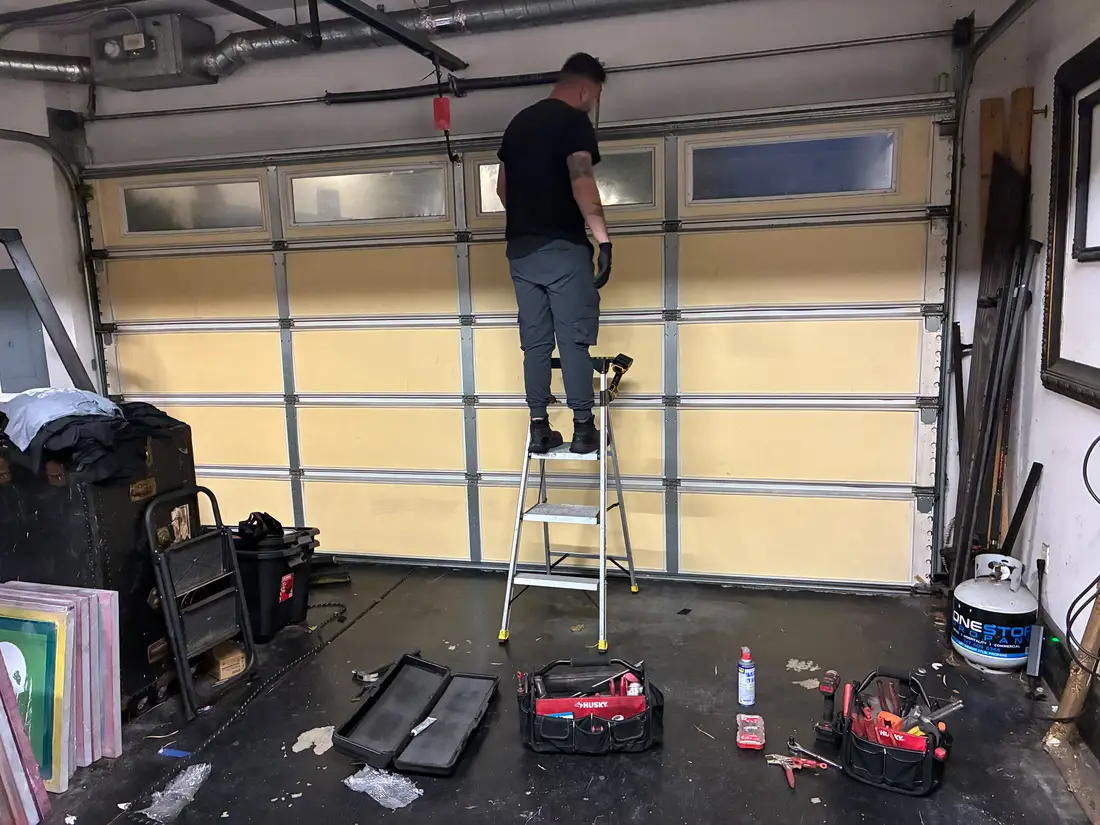
A garage door should hum, not perform. When the volume rises, the type of noise is a diagnostic clue — our repair technicians often know the failing part before they reach the door, just from the sound a homeowner describes. Here is the translation table.
Squeaking and squealing
Likely cause: dry metal-on-metal contact — unlubricated hinges, roller bearings or spring coils. Fix: lubricate with silicone or white-lithium garage-door lubricant at every hinge, roller bearing and a light pass over the springs. If squeaking persists after lubrication, a roller bearing is failing and the roller needs replacement — ignoring it turns a roller into a flat-spotted rattle, then a derailment risk.
Grinding
Likely cause: a worn opener gear, a damaged roller, or the door scraping the track or frame. Grinding from the opener head often means the nylon drive gear is stripping — look for white shavings inside the unit. Grinding from one side of the door means a roller or track problem on that side. Fix: gears and rollers are replaceable parts; track alignment is a technician's job. Continued grinding is continued damage.
Rattling
Likely cause: loose hardware — nuts and bolts vibrate loose over hundreds of cycles — or a chain drive with too much slack. Fix: tighten hinge, bracket and track fasteners (never the bottom-bracket bolts, which are under cable tension) and have the chain tension set correctly. A door that still rattles may have worn rollers with sloppy bearings. An annual tune-up includes the full hardware pass that prevents most rattles.
Banging or slamming
Likely cause: the door is out of balance (springs losing tension, so the door drops the last few inches), or sections are slamming over the track curve because rollers are worn. Fix: balance is spring work — professional territory. See the signs in our article on broken spring symptoms; a slamming door is a spring system asking for help before it breaks outright.
Popping
Likely cause: sections flexing as they round the track curve — often a sign of worn hinges or a door slightly too wide for its tracks after settling. Occasional pops on a cold morning are common; constant popping is wear talking. Fix: hinge inspection and, if needed, hinge replacement with the correct gauge.
Straining, humming opener
Likely cause: the opener lifting more than it should — a heavy, unbalanced door. The motor works harder, louder and hotter. Fix: fix the door's balance first; openers quiet down when the springs do their share. If the door balances well and the opener is still loud, consider a belt-drive model at replacement time — our opener page compares drive types honestly.
The rule of thumb
New noise is never "just how it is now." It is a part reporting wear while the fix is still small. Lubricate what you can reach safely, tighten what is safe to touch, and let a technician handle anything involving springs, cables or alignment. Quiet usually follows quickly — and so does a longer-lived door.
When loud means "call today"
Most door noises are wear, not danger — but a few deserve same-day attention. A loud bang followed by any change in how the door moves means a spring has likely snapped; stop using the door. A grinding or scraping that comes with visible crooked movement means something is out of the tracks' line — stop and call. And a door that has suddenly become much heavier to lift by hand is a spring system in distress. Those three are not "monitor it" noises; they are the door asking for a technician before a second, more expensive part joins the first.