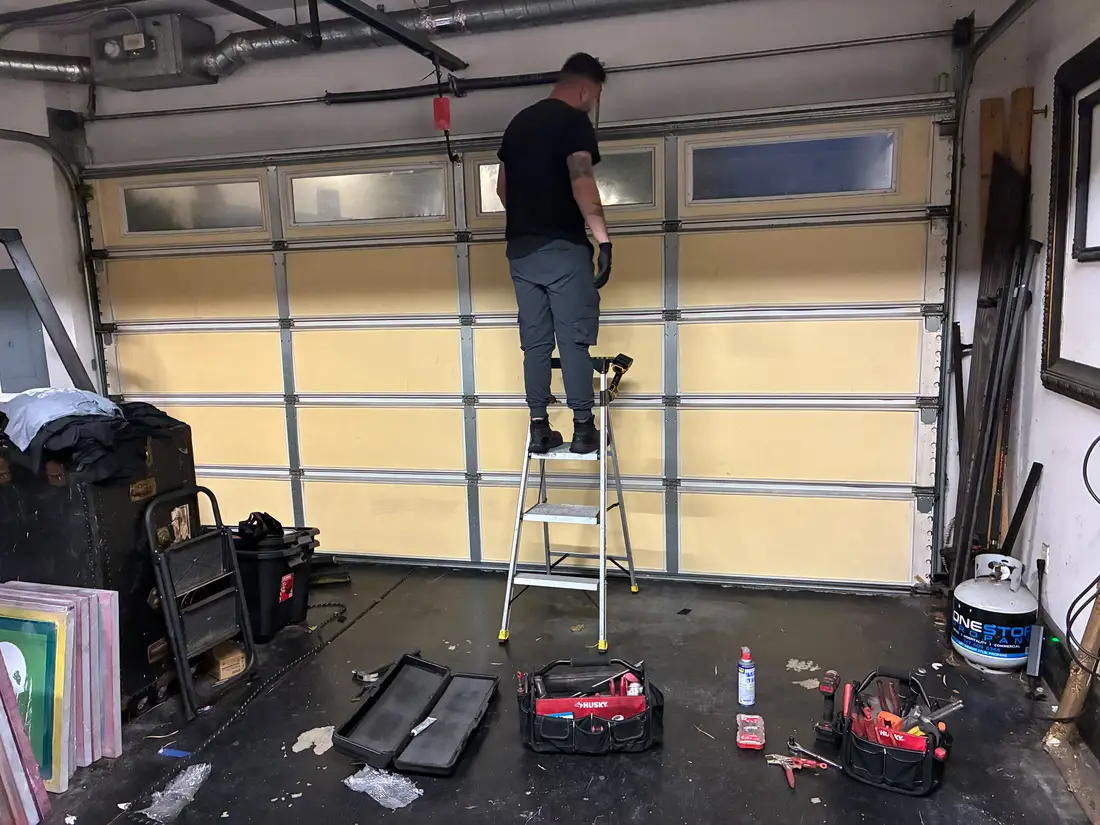
Few household failures are as disruptive as a garage door that will not open — especially with a car inside and somewhere to be. The good news: the cause is almost always one of nine things, and several can be identified in minutes. Here is the order a technician works through, and what you can safely check yourself before calling for garage door repair.
1. The opener has no power
Start stupid-simple. Is the opener's light on? Plug a lamp or phone charger into the opener's ceiling outlet to test it. Check the breaker and any GFCI outlet on the garage wall — a tripped GFCI kills the ceiling outlet too, and it is one of the most common "dead opener" calls we run. If the outlet is dead and the breaker is fine, the problem is electrical, not mechanical.
2. The remote or keypad battery died
If the wall button works but the remote does not, the remote battery is the prime suspect — replace it before anything else. If a keypad works intermittently, cold weather often exposes a weak battery. If no remote works but the wall control does, the opener may have lost its programming (after a power surge, for example) or the lock feature on the wall console may be switched on, which disables remotes on many models.
3. The photo-eye sensors are blocked or misaligned
The two small sensors near the floor must see each other. A storage bin, a broom, leaves, or a spiderweb across a lens will stop the door — usually on closing, but some openers refuse to run at all with a sensor fault. Both sensors have indicator lights; the receiving eye should be solid, not blinking. Clean the lenses with a soft cloth and nudge the brackets back into alignment.
4. The door is locked
Many doors have a manual slide lock on the inside, and many openers have a vacation/lock mode. If a family member locked the door — or a child found the lock button — the opener will strain briefly and stop. Check before you force anything.
5. The emergency release was pulled
If the red release cord was pulled (kids love it), the opener trolley is disconnected and the motor runs without moving the door. Most openers re-engage when you run the motor or flip the release lever back toward the door. Check this before assuming the motor died.
6. A spring has broken
The most serious common cause. Look above the closed door: a torsion spring with a two-inch gap in the coil is broken. The door then weighs its full weight — far beyond what the opener can lift — and typically rises a few inches and gives up, or does not move at all. Do not keep trying; you will burn out the opener. This is a job for spring replacement, and if the car is trapped tonight, our emergency service treats it as urgent.
7. A cable has snapped or slipped off the drum
If the door lifts crookedly — one side ahead of the other — a lift cable has broken or jumped its drum. Stop immediately: continuing can pull the door out of the tracks. Cables are under spring tension and are replaced in pairs by a technician.
8. The opener's gear or logic board failed
A motor that hums, clicks or runs without moving the chain or belt often has a stripped drive gear — a classic wear part, sometimes visible as white plastic shavings inside the unit. A completely unresponsive opener with a good outlet may have a failed logic board, especially after a lightning storm. Both are repairable on many models; on older units, replacement may be smarter — see opener installation for how we decide.
9. The door itself is damaged or off track
A roller out of the track, a bent track from a bumper tap, or a cracked panel binding in the opening can all stop a door cold. Look along both tracks for bends or obstructions, and check that every roller sits inside the track. Do not hammer tracks back yourself — alignment is precise, and a door under tension punishes guesswork.
The takeaway: power, remote, sensors, lock, release — those five are safe homeowner checks. Springs, cables and tracks are not. And if your door opened but sounded wrong doing it, book a tune-up and safety check before the small fault picks its own, worse, moment.
When to stop troubleshooting and call
Work the list top-down and stop the moment you reach anything involving springs, cables, tracks or a door hanging unevenly — those are the line between homeowner checks and technician work. Also stop if you smell burning from the opener, see sparks, or find the door partially fallen. Everything else on the list is fair game with basic care, and if you work through all nine and the door still will not open, tell us what you checked when you call — it genuinely shortens the diagnosis.